The Recycling Symbol Is Not a Promise
The recycling symbol is not a promise of local acceptance. Learn how to check collection rules and choose the right next step for each package.
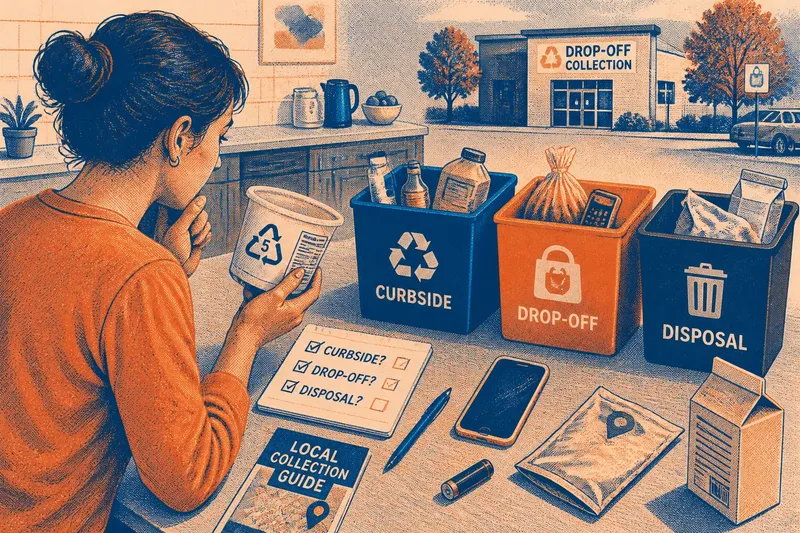
A recycling symbol on a package does not tell you whether your local program accepts it. The recycling symbol is not a promise about what happens after an item leaves your hands; it is a clue about material, packaging, or a manufacturer’s claim. To decide what to do, check your local collection rules and distinguish among three routes: curbside recycling, a separate drop-off program, and disposal when no suitable service exists.
What does the recycling symbol actually tell you?
The familiar chasing arrows can suggest that a package is recyclable, but the mark alone does not establish that a collection service takes it. Some packaging also carries a number inside the arrows. That number identifies a resin category, such as a type of plastic; it is not a universal instruction to place the item in a recycling bin.
Collection depends on more than the material. A program needs a way to gather, sort, and sell or otherwise process the item. Local equipment and contracts differ, so a container accepted in one town may be rejected in another. The label cannot show you those local decisions.
Nor does a symbol confirm the item’s destination. Collection is only one stage: materials may be sorted, sent for processing, or rejected because they are unsuitable or mixed with unwanted items. The mark is not a receipt for successful recycling.
When is curbside recycling the right route?
Curbside collection suits residents whose municipality or waste hauler lists the item as accepted. Check the current local guide, not just the package. Look for the exact material and form: a rigid bottle, a tub, a paperboard carton, and a flexible wrapper can face different rules even when they seem similar.
Consider the condition the program requests. Food residue, liquids, and loose caps can affect sorting, while guidance on rinsing, flattening, or keeping components attached varies. Follow the local instructions rather than adding extra preparation that the program does not ask for.
Say you have a clean plastic tub with a recycling mark and a paper label. Your city’s guide lists tubs but says nothing about removing labels. The sensible choice is to follow the listed acceptance rule and its preparation directions, rather than infer an answer from the symbol or guess that the label must come off.
This route is usually simplest when the local guide names the item clearly and explains how to prepare it. If the item is missing from the list, do not treat silence as permission.
When should you look for a separate drop-off?
Some items are collected through a special program rather than ordinary curbside service. Depending on local arrangements, that may include certain plastic films, batteries, electronics, or other materials that require distinct handling. A store, public facility, or municipal site may accept a specific item, but a collection point’s existence does not mean it accepts every similar product.
This option suits people who can confirm the exact item is eligible and can reasonably reach the designated site. Check the collection program’s accepted-material list and any packaging or preparation requirements before making the trip. For batteries or electronics, use the relevant local or manufacturer guidance; do not put an item in curbside recycling unless the local program explicitly allows it.
Imagine you have a clean shopping bag marked with a recycling symbol, but your curbside guide excludes plastic film. A nearby retailer’s posted collection information names shopping bags as accepted. That points to the retailer’s drop-off—not the curbside bin—as the appropriate route, provided the bag meets the program’s stated conditions.
What if neither program accepts it?
If you cannot find the item in curbside rules or a verified drop-off program, ordinary disposal may be the clearest choice. This can feel at odds with a recycling mark, but putting an unaccepted item in a bin can introduce material that the local system is not set up to handle. In some programs, that confusion can lead to sorting problems or rejected loads.
When the local guide is unclear, check the waste authority or hauler’s official materials, or contact them with the item’s name and packaging details. A brand’s recycling instructions can help identify a take-back option, but they do not replace local collection rules. Where guidance depends on a label, manufacturer instructions, or local rules, follow the relevant source.
Which recycling route fits your situation?
Can a resin number tell me which bin to use?
No. It identifies a plastic category, but acceptance depends on the rules and capabilities of the local service. Check the municipal or hauler guide for the item’s specific form.
Does a recycling mark prove the package will be recycled?
No. The symbol does not confirm that a local collector accepts the package or that it will pass sorting and processing. Treat it as a clue, not a record of what happened.
Should I put an uncertain item in the recycling bin anyway?
Not if the local instructions do not accept it or leave it unaddressed. Check the official guide or contact the service; if no suitable route is confirmed, use ordinary disposal rather than wish-cycling.
How can I choose among curbside, drop-off, and disposal?
Start with the local curbside list, then check a dedicated collection program if the item is excluded. Choose disposal when neither route confirms acceptance or the item fails the program’s conditions.
How can you make the decision quickly?
- Identify the item: Note its material and form, such as a rigid container or flexible film.
- Check the local curbside guide: Look for that exact item and follow its preparation instructions.
- Verify any special collection: Confirm the drop-off program names the item and is currently accepting it.
- Keep unlike materials apart when instructed: Packaging combinations may have separate rules for their components.
- Use disposal when no accepted route is confirmed: Do not let the symbol overrule the local service’s directions.
The useful question is not simply whether a package carries a recycling mark, but which collection route—if any—your community provides for that exact item. For the recycling symbol, local acceptance is the practical test; the symbol alone cannot tell you the outcome.