A Better Way to Follow a Long-Running Public Debate
A better way to follow a long-running public debate: use a brief reading routine to spot real decisions, separate recycled claims, and keep events in order.
A better way to follow a long-running public debate is to return to it with the same small set of questions, not to read every new reaction. A proposal about school boundaries, a transit route, or a public service can generate fresh headlines while its underlying arguments stay much the same. A brief routine helps you notice what actually changed and remember how the debate reached its current point.
The aim is not to build a complete archive or settle the issue. It is to keep a useful record: the question under discussion, any new decision or action, arguments that have resurfaced, and a short timeline. Set aside a few minutes when a new meeting, announcement, or report gives you a reason to check in. On quieter days, let the debate be quiet.
What is the debate actually asking?
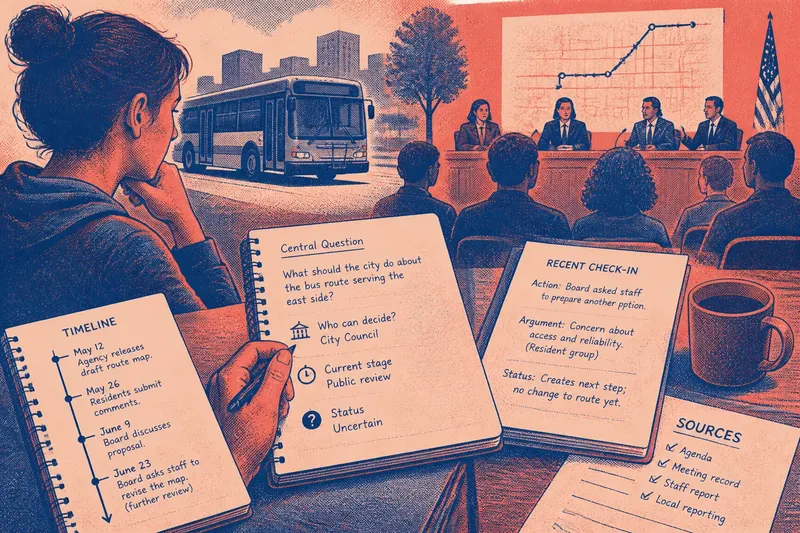
Start with one sentence that names the decision at stake. Keep it concrete enough that you could recognize an answer. “What should the city do about the bus route serving the east side?” is more useful than “What is happening with transit?” The first identifies a public choice; the second can expand to almost anything.
Under that question, note who has authority to act. A city council, school board, agency, court, or department may have different roles, and public discussion can blur them. The question might be whether an agency will recommend a change, whether an elected body will approve it, or whether a service will actually be altered. Those are related but distinct developments.
Write down the debate’s current stage in plain language: proposal, public comment, review, decision, or implementation. If you are unsure, mark it as uncertain rather than turning a headline into a conclusion. A story saying officials “consider” a plan does not mean they have adopted it.
Keep the question visible at the top of a note on your phone or in a paper notebook. When a new story appears, ask whether it addresses that question or merely shares the same subject.
When should you check back in?
Use occasions, not a rigid schedule, as your cue. A public meeting, a published agenda, a new agency document, a court filing, a vote, or a changed proposal can all justify a return. A reaction column that repeats familiar arguments may not. This keeps your attention tied to events that could move the debate forward.
If you want a routine over a week, choose one short check-in after a meaningful public event and one optional review later in the week. Before the event, look at the agenda or announcement so you know what is expected to happen. Afterward, check for a record of what did happen. The gap between those two is often where the useful information sits.
Do not treat a promised announcement as the announcement itself. An agenda may say an item will be discussed; it may be delayed, revised, or referred elsewhere. Record the event only after you can identify what took place, and leave the outcome open if no clear record is available yet.
Imagine you are following a proposed change to library hours. The board’s notice says the issue is scheduled for discussion, so you write “discussion expected,” not “hours changing.” After the meeting, you find a public record showing that staff were asked to prepare another option. Your note now records a request for further work, while the hours remain unchanged. That distinction gives your next check-in a clear purpose.
How do you tell a new decision from a repeated argument?
Separate what happened from what people say should happen. A new vote, formal referral, revised draft, or published finding may alter the debate’s status. A familiar claim about fairness, cost, access, or responsibility may be important, but its reappearance does not itself change the status of the proposal.
For each item you read, make two brief notes:
- Action: What did an institution or participant do? Identify the actor and the action.
- Argument: What reason or concern was offered? Note whose view it is, rather than presenting it as settled fact.
- Status: Does this alter the proposal, create a next step, or leave the current position unchanged?
A claim can become newly relevant if it appears in a formal document, prompts a response, or leads to a changed proposal. The point is not to dismiss recurring arguments. It is to avoid mistaking repetition for a decision. If a point is familiar but now attached to a new action, record both.
Watch verbs closely. “Proposed,” “approved,” “referred,” “scheduled,” and “implemented” describe different stages. Headlines may use broad language; the underlying document or meeting record can clarify what the verb means in context. If the record is not available, say what the source reports and keep the status provisional.
What belongs in a brief timeline?
A useful timeline is a memory aid, not a transcript. Give each entry a date or a clear time marker, name the actor, and state the action in one sentence. Add a link or document title if you may need to return to the source. Keep competing interpretations out of the event line; place them in a separate note as arguments.
For example, a timeline might read: “Board posts draft route map”; “Residents submit comments”; “Board asks staff to revise the map”; “Revised map released for another review.” The sequence shows movement without claiming that the final route has been chosen. If an entry is corrected later, edit it and note the correction rather than quietly leaving conflicting versions.
Preserve only details that help answer the central question: what is proposed, who can decide, what has happened, and what remains unresolved? A long list of every interview and reaction can bury the turning points. The brief format also makes it easier to resume after a break without rereading everything.
Use the same terms throughout. If you call a document a “draft” in one entry and a “plan” in another, a reader may assume its status changed. When a new version appears, identify it as revised and note what changed only if the difference matters to the decision.
Which sources help at each stage?
Match the source to the claim you need to check. An agenda can confirm what is scheduled. Minutes, a recording, or an official notice can help establish what happened. A draft or final document can show the wording under discussion. Reporting can add context, explain disagreements, and identify consequences that an institutional record may not address.
These sources do different jobs. An official document can establish an institution’s stated action, but it may not explain how affected people experience the issue. A resident’s account can illuminate a practical concern, but it does not by itself establish what the whole institution decided. Keep the source and the type of claim visible in your notes.
When accounts conflict, write down the point of disagreement rather than forcing an early resolution. For instance, one source may describe a proposal as a cost-saving measure while another says it would shift costs to users. Those claims can concern different parts of the same plan. Look for the relevant document or a clear explanation of the assumptions behind each account.
Labels, procedures, and local rules can shape what a document means. When the interpretation depends on them, check the source material or ask a qualified professional where appropriate. Do not infer a formal outcome from a summary that leaves the process unclear.
How can you keep the routine useful without making it a chore?
Set a stopping point for each check-in: answer the central question as far as the available information allows, update the timeline, and write down what would make you return. That next cue might be a scheduled vote, a revised document, or a decision expected from a named institution. If nothing has changed, record “no new action identified” and stop there.
Make your note easy to scan. Put the current question first, the latest confirmed action next, then the timeline and unresolved points. Avoid copying whole articles. A short quotation may help when exact wording matters, but otherwise summarize the claim and retain a link to its source.
Keep distinctions visible when a debate moves across institutions. A recommendation from staff may go to a board; the board may defer action; another body may control implementation. Add the handoff to the timeline. It explains why a public debate can remain active even after one participant has finished its part.
If the issue grows beyond your original question, decide whether the new subject is necessary to understand the decision. If it is, revise the question clearly and note when you did so. If not, keep it in a separate note. A defined scope makes it easier to tell whether a story is a genuine update or simply an adjacent issue.
What should you do when the timeline is unclear?
What if an announcement has no supporting document?
Record who made the announcement, where it appeared, and what it says, but mark any missing detail as unconfirmed. Look for a later agenda, formal notice, recording, or revised document before changing the debate’s status.
What if two sources give different dates?
Check what each date refers to: a meeting, a publication, a filing, or a decision taking effect. If the difference remains unresolved, preserve both descriptions with their sources instead of choosing one by guesswork.
What if no decision has been made?
That is a valid timeline entry when a relevant event occurred without a decision. State what happened, identify the next known action if there is one, and leave the outcome open.
What if a recurring argument matters more than a new vote?
Give the argument its own note and identify who is making it and what evidence or experience they cite. Keep it separate from the action line so readers can see its importance without mistaking it for a formal decision.
When is a debate ready to leave your regular watch?
Pause routine check-ins when the central question has been answered, the responsible institution has finished its stated process, or no meaningful next action is on the horizon. That does not mean the issue is permanently settled. It means your note has reached a natural stopping point.
Leave a final status line that distinguishes the decision from its consequences. A policy may be approved while implementation remains pending; a proposal may be withdrawn while the underlying problem remains. If a later event reopens the question, your timeline can help you resume without treating old arguments as new developments.
A better way to follow a long-running public debate is to return when the public record gives you something specific to check. Keep the question narrow, label actions and arguments separately, and make the timeline short enough to use. Your next reading session will be clearer if the note ends with one unresolved question and the event that could answer it.